







Fisher Jones Family Dentistry

The Thanksgiving Season

Dr. Jim here! With Thanksgiving Day fast approaching, on bahalf of the entire Fisher Jones Family Dentistry team, I would like to wish all of you a hapy and safe Thanksgiving holiday weekend. If you are traveling, we hope you arrive and return safely, especially with the changes in weather this time of year. We hope you are enjoying some all important family time with those who are close to you.
the Jones family had an opportunity this last weekend to spend some time at the Thurston County Food Bank putting together some food boxes for those in need. They have an amazing, inspiring operation there and are providing a vital service to our community. If you ever get the chance to volunteer your time there it would be greatly appreciated. While there is abundance in our community, there is also great need, and seeing the amount of food that will be donated to people really brings that to light.
Our office will be taking the weekend off as well. However, if you do have a dental emergency, we will be available to take your call and see you in the office if necessary. Just call the answering service at 360-704-7076 and they will get you to either Dr. Matt, Dr Garrett or myself, Dr. Jim.
Look forward to seeing you in December, and, remember, if you haven’t used your dental benefits for this calendar year, time is running our! Call us on Monday if you have any dental needs not yet met.

Tags: , , ,

Uh Oh! I cracked my tooth!

Dr. Garrett here!  With the holiday season fast approaching we have many wonderful things to look forward to.  Meals with family, travelling, gifts, and sharing time with our loved ones are just a few of the great things about the holidays.  At my house, Thanksgiving is an absolute feast as my wife Allison has a chance to put her skills as a chef on display!  The last thing anyone wants to deal with during this time of year is a broken tooth.

So what should you do if you find yourself chomping down into a nice tasty turkey leg and suddenly hear a “crack” from one of your teeth?  First, call our office!!!  We have an on-call service that will direct you to one of us doctors so that we can help determine if you need emergency treatment or if you can wait until a later date.  If you are out of town or do not have access to a phone, things get a bit more tricky.  First you need to look into your mouth and determine how much of the tooth has broken.  A small chip that elicits no pain or discomfort can usually be dealt with at a later date.  If the tooth is constantly aching and has a very large piece missing or mobile, you may have cracked the tooth down into the root and require immediate help.  In addition, if there is blood coming out of the tooth the nerve may have become exposed and emergency treatment will be necessary.  If there will be an extended period of time before you can see a dentist, it will be very important for you to keep the broken tooth clean and out of further harm’s way.  Eat on the opposite side of your mouth or stick with foods that are softer and do not require you to chew them.  A salt water rinse after eating will help to keep the tooth clean.  Most drug stores carry paraffin wax that can be used to cover the tooth and save your tongue and cheek from sharp spots.

Hopefully, everyone will get through the holiday season with all their teeth intact.  If an emergency does arise, however, know that we are always here to help out you and your loved ones.

Tags: ,

Chemotherapy, Radiation and Dentistry

Dr. Matt here.
There are many reasons for using chemotherapy as a treatment. It is important that you include your oral health care providers early on. We recommend if possible one month prior to treatment. The Dentist and Dental Hygienist will develop a management plan to help aid in your care as you go through treatment. Here is a helpful website that can answer most of your questions.

http://www.nidcr.nih.gov/OralHealth/Topics/CancerTreatment/ChemotherapyYourMouth.htm

Summary. See your Dentist/Hygienist or have a conversation one month prior to treatment. Chemotherapy doesn’t always affect your oral health in a bad way but when it does it can be complicated. Sometimes eating, swallowing, and getting comfortable can be difficult. Most common are mouth sores, decreased saliva, taste changes and discomfort. An initial assessment is important because it gives a baseline prior to starting your treatment.
Often we will fabricate trays that fit your teeth to administer calcium and fluoride topically everyday. Additionally we want you to drink a lot of water. Pick up some candies with xylitol as the first ingredient to help with the effects of dryness. We also will want you to use a saliva substitute at nighttime if your mouth remains dry during and after treatment. If things get bad there are prescription rinses available to help. A home remedy is warm water with a little baking soda and salt to rinse with. You may need to slow down your eating and use water to moisten your food as you go, smaller bites, and slowing the mealtime down.
You may want to avoid crunchy hard foods, acidy foods, sugary foods, tobacco, and alcohol.
For information on dry mouth we have found this website to be helpful.

http://www.mayoclinic.com/health/dry-mouth/an02112

Radiation therapy may be part of your treatment as well as Chemotherapy and even surgery too. So planning ahead is time well spent. Communication between you and all caregivers is helpful. Radiation even if it is not to the head and neck can have oral complications. All the treatments can affect the entire body. Sometimes if radiation is planned for the head and jaws shielding with special oral devices may be necessary. This is standard now but hasn’t always been. It is worth talking about. “Do I need to have my teeth shielded from the radiation beam?”
It is hard to predict how the treatments will go but talking about it and coming up with a plan is helpful.

Your Appointment Reminder

Dr Jim here!
Raise your hand if you have a cell phone or smart phone!
Everywhere I go I see people attached to their iPhone, Droid, S4 etc as if it is their lifeline to the world. I have to admit I am completely reliant on mine as well. They seem to have almost replaced the home telephone answering machine. It is because of this evolution that we have changed the way we communicate with you when we want to remind you of your upcoming appointment.

We have been asking you over the past year or so if you want to be reminded of your appointment by email, text or phone call. This was in preparation of bringing on a service that will give us all of those communication options. The name of the program is Smile Reminders and I wish I had thought of this idea! We now have the ability to send you a text message reminder and email, or phone call. It seems most people prefer text messaging as it comes right to our cell phones no matter where we are. I can tell you that at our home we are often remiss in checking our answering machine voice mail because we hardly use our land line anymore and even more so, check the US postal mailbox even less.

We also now have the ability to ask you some short survey questions about your visits with us in order to make sure we are providing you with the best dental experience possible! As this service continues to evolve, it will make our communications even more efficient.

So look for a text or email from us reminding you of your upcoming appointment with Dr. Matt, Dr. Garrett, myself, or one of our wonderful hygienists. We look forward to seeing you!

Invisalign for your health!

Dr. Garrett here! Many people look at orthodontics simply as a way of making their smile more cosmetic. Although this is a result of ortho, there are many other benefits to having proper tooth alignment. Here is a wonderful video demonstrating how orthodontics can help not only improve your smile, but also help prevent the long-term damaging effects of malocclusion. Make a free consultation with Dr. Jim to discuss your orthodontic needs! He is our Invisalign guru!

Tags: ,

Easy Oral Hygiene

Dr. Matt here. I want you to be aware of how well you can take care of yourself between your dental checkups. Besides eating a variety of foods and getting enough quality sleep there are two personal care items that we recommend highly. They are Sonicare toothbrushes by Phillips (www.sonicare.com) and the Shower Pick by Oral Breeze (www.oralbreeze.com).

Sonicare is based on innovative patented sonic technology.  That is what makes it so effective.  High frequency and high amplitude motions create a dynamic cleaning action that drives fluids deep into the tight spaces between your teeth and along the gum line, which results in a cleaner and healthier mouth.  Oral irrigators are a great adjunct to dental flossing by pulsing a small stream of water at a high pressure in between your teeth.  This helps loosen plaque and any food particles from between your teeth helping in the fight against gingivitis and  bleeding gums.


Oral Breeze irrigators come in a variety of options and sizes such as counter top models, portable handhelds, and even ones that can attach to your shower or faucet.  These devices are perfct for helping anyone maintain a healthy clean mouth.  Our favorite is the Shower Breeze.  During your shower you divert a little water into the patented valve and point the irrigator tip at the tooth-gum interface.  The water flow dislodges food particles and promotes healthy tissue changes.

There are many dental hygiene products to choose from.  Sonicare and Oral Breeze are two of our favorites.  Smiles to you and see you at your checkup. 🙂

Tooth Avulsion (knocked out tooth due to trauma): Attention: Coaches, Parents and Kids!

Dr. Jim here! As a follow up to Dr. Garrett’s post on athletic mouth guards, I wanted to talk about tooth avulsion also known as the complete loss of a permanent tooth out of its aveolar socket, usually by trauma. This is something we typically see during the summer when kids are more active,  and when kids and adults are involved in competitive sports.   Baseball, soccer, basketball, rugby and hockey are sports that often result in teeth being knocked out as well as activities such as skating, roller blading, jumping on a trampoline and general rough housing.  Perhaps surprisingly, it isn’t as common to have tooth loss in Football because mouth guards are mandatory.

The following is a helpful guide if you, your child or a child you are coaching loses their permanent tooth.  If permanent teeth are handled correctly, they can be successfully and permanently replanted, as seen below.

If a tooth is avulsed, make sure it is a permanent tooth (primary teeth, aka: baby teeth- should not be replanted).
•Keep the patient calm.
•Find the tooth and pick it up by the crown (the white part).  Avoid touching the root.
•If the tooth is dirty, wash it briefly (10 seconds) under cold running water and reposition it. Try to encourage the patient or parent to replant the tooth. Have the patient bite on a handkerchief to hold it in position.
•If replanting the tooth is not possible, place the tooth in a suitable storage medium.  Suitable mediums include:   a glass of milk;   a special storage media for avulsed teeth  (e.g. Hanks balanced storage medium or saline);  in the mouth- keeping it between the molars and the inside of the cheek; and, if there is any chance the patient might swallow the tooth- get the patient to spit in a container and place the tooth in it. Avoid storage in water!
•Seek emergency dental treatment immediately.
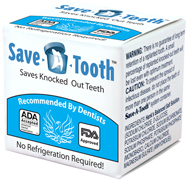
All athletic first aid kits should include a storage medium like “Save A Tooth.” It is a balanced salt solution that preserves the tooth for up to 24 hours . It can be purchased on various websites including Amazon.com. I have frequently given them out to patients to give to their coaches.  I strongly recommend purchasing a container for you household and car first aid kits.

Play hard and stay safe!

Mouthguards

Dr. Garrett checking in!  As football season get’s under way, I am reminded instantly of the frequent mouth injuries we see in the office this time of year.  Mouth injuries that could have easily been prevented if a mouthguard was worn.  From youth beginners to weekend warriors, it is very important that you protect your teeth during any sport with the potential for facial trauma.  Can you imagine losing your front teeth?  The inability to bite into an apple or smile with confidence becomes an instant reality.

So what types of mouthguards are out there?  Lots!  There are three main types, however, that we can look at:

-the stock mouthguard which is preformed and requires no fitting prior to wearing

-the mouth-formed “boil-and-bite” mouthguard

-the custom-made mouthguard fabricated by a dentist

The most effective mouthguard should be tear resistant, comfortable, resilient, and have a snug fit.  A stock mouthguard has the advantage of being very inexpensive, but the fit is usually very loose.  We do not recommend this type of mouthguard.  A boil-and-bite mouthguard can be a very a very effective way of protecting your teeth.  It is important to follow the instructions closely on the proper way to fit it to your teeth, otherwise you risk having a mouthguard that falls out during your sport.  Be sure to look for a mouthguard with high quality material that will stand up to frequent usage.  The gold-standard (of course) is the custom-fit mouthguard made by a dentist.  The thickness of the material can be perfectly uniform and the fit is phenomenal.  Also, we can often make custom colors which can be a fun way to promote the mouthguard actually being used!  Expect the cost to be higher, but the lifespan to be much longer than any mouthguard purchased in the store.

Care of your mouthguard is an important aspect that is often overlooked.  Always rinse it after use with either water or an antiseptic mouthrinse (like Listerine).  You can also brush it with a toothbrush and toothpaste.  When you are not using it, be sure to store it in a container that allows air circulation so it does not get moldy (and stinky!).

Be sure to bring your mouthguard in with you to your dental check-ups.  This will allow us dentists to check that it is fitting accurately and in good condition.

So go out there and get some exercise, but be sure to protect your teeth when necessary…or you may be seeing me for some implants!!

Tags: , , ,

Dental Caries

Dr. Matt here.  What is Dental Caries?  Dental caries is tooth decay. Specific bacteria (Streptococcus mutans, Streptococcus sobrinus, lactobacilli and more) on the tooth surface feed on carbohydrates and make acids as waste products.  Acids travel into the tooth and dissolve out minerals.  If mineral loss is not halted or reversed a cavity is formed.  Dental caries is a transmissible bacterial infection.  Transmissibility can be stopped by the use of Xylitol a naturally occurring alcohol sugar in the form of toothpastes, mints, candies, rinses and many other forms.  Right now my personal favorite xylitol hard candy is the brand Ice Chips made in Yelm Washington. We recommend kids up to age 6 brush with xylitol toothgel by SPRY.

You can get it on the Net or at health food stores.  Many other types are main stream and can be found at Target and Safeway. Transmissibility is how you get a cold through casual contact, so it may be shocking to know that your sitter might be giving your kids pathogens that cause cavities. Crazy.  Mineral loss can be controlled using calcium paste in trays or rub on.  The brand that I like right now is MI Paste.  You put a pea size amount on your finger while you are laying in bed rub it onto your teeth, move it around with your tongue and you can swallow it.  Think of it as night cream for your teeth.  If you need more fluoride in the teeth there is prescription strength toothpaste which can be used in combination with calcium paste.  So get diagnosed.  Kids can have extra fluoride in drops and tablet prescription. Teeth should feel smooth like glass not rough like wood.  If you reverse the woody feeling soon enough a hole may be prevented.  Yes prevented.  Some people are in a high risk group for decay and others are low risk.  Decay or no Decay is a balance “The Caries Balance”.  Think about a teeter totter. On one side you have protective factors like: saliva flow and its components, brushing/flossing/irrigating, Phosphate, Calcium, and Fluoride remineralization, and antibacterials like chlorhexidine,xylitol.  On the other end you have Pathological factors: acid producing bacteria, frequent eating/drinking of fermentable carbohydrates, poor oral hygiene practices and sub-normal saliva flow, function.  It is a balance of Caries – No Caries.  Dental Caries is a Disease process and drilling does not fix the disease.

Gum Disease and its Relation to Alzheimer’s Disease

Dr Jim here! A recent study published in the Journal of Alzheimer’s Disease revealed that a bacterium linked to gum disease was present in the brains of many Alzheimer’s patients. The study, was performed at the University of Central Lancashire in England. It showed that the bacterium Porphyromonas gingivalis was present in 4 out of 10 samples of brain tissue from Alzheimer’s patients compared to no signs of this bacterium from brains from people of similar age who never developed Alzheimer’s.

What does this mean? It further supports the theory that bacteria present in your mouth enter the bloodstream though chewing or tooth removal and end up in other parts of the body, including the brain. Theory suggests that, over time, chemicals produced by the bacteria can build up and contribute to the development of Alzheimer’s. According to StJohn Crean, dean of the School of Medicine and Dentistry, “We’ve shown an association, not causation. It does nothing more than prove that these bacteria do get to the brain.”

From our perspective, it further supports the basis of our practice that you must see your dentist (Fisher Jones Family Dentistry) on a regular basis and stay current on your dental hygiene schedule. Bacteria colonies repopulate your gum tissues every day so it is important to be seen by a hygienist at least 2 times a year (more for those people with gum disease) in order to reduce these bacteria colonies.

Fisher Jones also provides a simple spit test that can analyze the different types of bacteria in your gum tissues, identify specific high risk pathogens like Porphyromonas gingivalis, and create a program specifically for you to reduce their levels. The test is called MyPerioPath and it is very accurate in identifying the type of bacteria present in your gum tissues and their relative numbers. Call or ask us about this test at your next appointment. Something so simple can provide such important information that can improve your quality of life.

Tags: , ,